Subscribe

Wednesday, April 27, 2022


             TALKING ABOUT MONEY IS IMPORTANT – EVEN IN CHURCH


            Too often, we avoid talking about money in church, don’t we? Sometimes it’s because we’re uncomfortable talking about money at all; sometimes it’s because we’re in church; and sometimes it’s because people hate it when we talk about money.
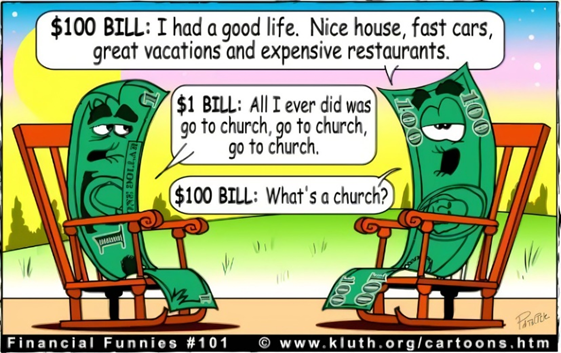

            If we believe that what is said from the pulpit is important to people, then money should be talked about from the pulpit, because money is important. An article I read said when we don’t talk about money, we’re implying:

1.    Money isn’t important; or

2.    God only cares about the money you give; or

3.    We don’t talk about money in the church, so you’ll need to find out how to manage your money from the world.

Ouch! I’m not sure any of those implications is what we should be relying upon!

            I’m not saying we only talk about money, but people deal with money every day, and many times every day, so they need our help, our wisdom and our encouragement in handling and managing it.


            Jesus talked about money in his teaching about 15% of the time! So not talking about money takes a pretty good chunk out of the New Testament, doesn’t it?

            How about if we talk about money, sharing God’s financial principles and providing them with the tools that will help them fight against the world’s influence?

            I encourage you to think about sharing money in this way, instead of only doing it under protest, and only when we want money FROM people!


            It’s not too late to attend the Stewardship Academy. The next session is being held May 21st at 10 a.m. via Zoom. If you are interested in a registration form or information on the academy itself, please let me know (susanranous@unyumc.org)

Thursday, April 21, 2022


                                        WITNESSING TO GENEROSITY


            When we give inside church, during worship, it is a matter of public worship, and we are witnessing to our generosity. When we can’t pass the offering plates, that public witness is much more subtle.


            How else can we witness to our generosity?

·         Testimonies

·         Telling stories of generosity

·         Telling what generosity accomplishes in service of God’s mission

            Don’t fixate on the face that offering plates aren’t being used like they used to be. I don’t know how to break it to you, but they may never be used the same way again!

            And that’s okay. We just need to provide opportunities to give in as many different ways as possible. There need to be a variety of ways to give. Have you noticed fewer and fewer people actually have a checkbook or cash on them now-a-days. That means passing the plate wouldn’t work, even if we could.


            There has been appositive result of the pandemic, and that is churches that hadn’t been providing online opportunities to give had to start online giving when their church buildings were closed.

            Let’s embrace new and varied ways of giving, but, most importantly, keep offering central to worship and invite everyone to give.


            REMINDER: The Stewardship Academy is being held April 23rd, May 21st, June 18th and July 16th from 10 a.m. to 3 p.m. If you are interested in a registration form or information on the academy itself, please let me know (susanranous@unyumc.org)

Monday, April 11, 2022


                    GIVING WHEN THERE’S NO OFFERING PLATE #2

            It’s been a couple of weeks since I’ve offered a blog, but I wanted to continue our discussion on giving when there’s no offering plate.

            When we used to pass the plate, there was a little bit of peer pressure, and people knew (usually) what they were supposed to do: drop a little something in the plate. Some people didn’t like it. But there was something to be said for a connection with each person in the pew. When the person sitting right next to you is passing you the plate or basket, it can’t be ignored, can it?


            Now, the plate or basket may be placed at the door or somewhere else. For those of us familiar with that particular church, we know where to look. But what about others. My husband and I visited a church recently. We’d been there before, but that was back “before.” I had pulled the money out of my wallet and placed it just inside my purse so I could easily drop it in the plate when it came by. And then…I watched the usher stride up the aisle right to the altar table and place the offering plate there to be prayed over.


            I’d missed my chance! Steve looked at me and muttered “I didn’t even see where to put the money when we came in.” It probably was easily found, but, even now, stewardship or not, two years hence or not, I seldom think to look for the plate on the way in.

            Then there are those persons worshipping virtually. While we may give them QR codes or links to go to make an offering, there doesn’t seem to be much of a connection between the offering and the worshipper, does there?


            We have to make the offering, whether it’s in person or virtual; whether a plate’s being passed or stashed somewhere else; connected to everyone. The offering time isn’t just a throw away moment; it is a vital part of worship.

            It’s important and it should be joyful! I encourage you to go to Youtube and type in "church offering dance" and see what pops up! Wouldn’t it be exciting if offerings were done that way?

            REMINDER: The Stewardship Academy is being held April 23rd, May 21st, June 18th and July 16th from 10 a.m. to 3 p.m. If you are interested in a registration form or information on the academy itself, please let me know (susanranous@unyumc.org)

Friday, March 25, 2022


                     GIVING WHEN THERE’S NO OFFERING PLATE #1


            Remember the “good ole days” when we had ushers greeting people in the church and they’d go through the sanctuary and pass the offering plates? People would pass the plate from person to person throughout each pew, putting money, change, and checks into the plate. Oh the memories!


            The pandemic changed how we give, didn’t it? Some churches had the option of online giving before March 2020, but, still, the majority of folks gave by bringing checks or cash to church on Sunday mornings.

            Church buildings closed in the spring of 2020, and worship no longer was in person. It had to done via Zoom, or livestream, or Facebook live, or recorded. I don’t know about you, but I know I spoke about continuing to support the church even while we weren’t meeting in person. Some people were very diligent and continued to send checks to the church. Others switched to online giving. Churches that had never considered online giving before suddenly had to consider it!


            Even with those conversations, other conversations talked about if we just get back together in person, giving would go back to how it used to be. Thing is, when we were able to gather together inside church buildings in person, not everyone came back and we weren’t passing the offering plates any more. They resided in the back of the sanctuary so people could drop their offering in when they came in or when they departed. We continued to encourage people to give electronically if they couldn’t be there in person. It wasn’t the way it used to be. We seemed to lose the entire ambiance of giving time.


            When we couldn’t pass the plates, giving time seemed to become almost a “throw away” moment in the service where we reminded folks to put their offering in the plates if they hadn’t already done, and click on the QR code on the screen or go to the website and make an online donation. Not much more than that.

            Giving time needs to be more what it was, and that doesn’t include brass offering plates or ushers passing them among worshippers. Offering needs to be central to worship. It’s more than a way to pay bills. Our financial gifts should be a sacrifice of what we would normally use to support ourselves. They must be a tangible expression of our love of God. Any sacrificial giving to God still needs to be an important part of worship. Giving is as important to a person’s worship of God as prayer, Scripture or a sermon!


·         Have a designated time to invite giving

·         Explain the theological significance of giving

·         Share the stories of the good that happens because of giving.

·         Dedicate or bless the gifts, those held in the plate, and those that have already come in electronically.


            It doesn’t matter HOW giving is done; but the connection between giving and worship has to be reinforced.


            REMINDER: The Stewardship Academy is being held April 23rd, May 21st, June 18th and July 16th from 10 a.m. to 3 p.m. If you are interested in a registration form or information on the academy itself, please let me know (susanranous@unyumc.org)

Wednesday, March 16, 2022


                                    GRATITUDE OR GREED #3?


            I’m continuing my discussion on gratitude versus greed. Last week, I talked about being grateful for what we have now. This is the way to find a balance in our finances.

            Have you seen posts on Facebook where people make a post every day saying something they’re thankful for? That requires a conscious decision to choose the positive over the negative. Some people start a “thankful” journal, where each day they write down three or four things they are thankful for. That’s a lot of thankful, isn’t it?


            Not only is it a lot of thankful items, but coming up with all those positive things, requires you to practice being grateful. And being grateful influences your attitude and perspective.

            What if our churches practices being grateful? Too many times, we focus on what we can’t do, the money that isn’t in our checking account, and how few people are in our pews, or the lack of children. We spend our time focusing on “if only”.

            A few years ago, I was asked by a church to speak to the congregation about their “financial realities.” The church leaders didn’t want to give bad news to the congregation, and thought an “outsider” would be the way to go. That way, when the congregation became angry, they had someone to blame.


            I agreed to speak, but I also insisted that the leaders speak. I didn’t want them to talk about bad news, about what they didn’t have, about possibly letting staff go, or stopping ministry. I wanted them to talk about what that church has consistently been able to do in the past, solely because of the generosity of the congregation. I also insisted that not just the financial people, but other folks, teachers, youth, missionaries, people who had participated in the ministries of that church, get up and share those stories. Then, and only then, did I agree to speak, reinforcing the gratitude and the thanksgivings, but stressing that those positive stories happened because of them.


            It was up to them to determine what ministries were going to be able to continue, and money and finances were a way of funding those ministries.

            Of course, some people were upset, and some were sad, but they heard the stories of thanksgiving, and within two months, were able to raise additional pledges that allowed ministries to continue.


            Let us being thankful, not reaching for our wallets, but reaching for God. Practice gratefulness. Practice may not make perfect, but our hearts will change!

            REMINDER: The Stewardship Academy is being held April 23rd, May 21st, June 18th and July 16th from 10 a.m. to 3 p.m. If you are interested in a registration form or information on the academy itself, please let me know (susanranous@unyumc.org)

Wednesday, March 9, 2022


                                    GRATITUDE OR GREED #2?


            Last week, I talked about reaching and needing more, both as individuals and as churches. I have to say, the more I’ve thought about it, the more I can start to understand that practice or theory. We want to spend on things that make life more enjoyable and fun, but we also have to safeguard our future. Spending is fund, saving—not so much. Maybe balance is the answer.

            When I’ve spoken about saving and budgeting with kids, I’ve used a piggy bank that I found online several years ago. It’s similar to the one shown here, although mine is silver. There are four slots in the top. One slot goes to the “save” section, one to the “spend” section, one to the “donate” section and one to the “invest” section. The cool thing is each section also has one of the pig’s feet attached. So once you’re reading to spend your “spend”, you can unscrew the foot that’s labeled “spend” and the money in that section comes out!


            It really helps picture how each piece of money someone has can be utilized. Four slots, four sections, four feet; it’s all a balancing act, isn’t it? Even thought we don’t use a piggy bank with different sections, we have to make choices as to where each piece of our money goes. How do we decide when things are competing against each other?


            An article I recently read said it is a choice, and sometimes the choice seems difficult. However, for the author, maintaining the proper balance isn’t that hard. The author says the key is gratitude—being grateful for what you have, a spontaneous emotion that comes from within. I easily understand that definition, but the author says it’s not just an emotional response, it is a choice.

  • ·         We can choose to be grateful, or
  • ·         We can choose to be ungrateful – to take what we have for granted.

            What is your choice? What will you choose? Are you grateful for what you have, or just need to keep it all for yourself?


            This are good questions and considerations for each of us as individuals. BUT a church must consider these questions as well. Too often, it seems like a church sits down, focusing on what they have (or more often, on what they don’t have), and spent an entire meeting trying to find a way to fund what they have and what they want, not what is needed by their neighbor, or community, or God.


            So, make your choice!


            REMINDER: The Stewardship Academy is being held April 23rd, May 21st, June 18th and July 16th from 10 a.m. to 3 p.m. If you are interested in a registration form or information on the academy itself, please let me know (susanranous@unyumc.org)

Friday, March 4, 2022


                                         GRATITUDE OR GREED #1?

            Let’s be honest! If you were asked “do you want more?”, how would you answer? Most of us would answer “yes”, whether it’s career, relationships, money or anything really. It’s how the world around us functions, and how we live in that world. There are a lot of phrases or sayings that speak to this. Two of them are:


  • ·         Keeping up with the Joneses
  • ·         The grass is always greener on the other side of the fence

            I find that when I am in need, or worried, or suffering, that my prayer life is pretty good. Asking God for help or asking God to heal a loved one. That come’s pretty easy, doesn’t it? But when I’m doing okay, or things are going well, or the bank account is full, my prayer life may not be all it should be. It’s easy to forget God when things are going well. But when we don’t have much, we’re usually more grateful for what we do have.


            The conversation around scarcity versus abundance often seems to focus on God providing enough. The church needs to focus on God’s abundance, not our scarcity. Let’s look at it a little differently, when abundance actually causes a problem:

            When we personally experience abundance, having more than we need, we start to lose our way, constantly reaching for what we don’t have and wanting more. Even though we have more than we could possibly use, we reach for more and more “stuff.”


            Churches can have this same problem.

  • ·         I’ve worked with churches who have a very small checking account, and struggle week-to-week to keep the lights on, pay the pastor, and do mission and ministry. Some of those churches seem to be fixated on scarcity, not having enough to be able to do “everything” they want. While others see that God has provided what they need to be able to be the church of God.
  • ·         I’ve worked with other churches, whose checking accounts are fairly flush, and who have large endowments. Sounds like a dream come true, doesn’t it? Problem is, some of the people sitting in the pews figure that the church already has enough and so don’t contribute generously. This is an issue that hurts the people, taking away their need to give and support the work of God. It’s also an issue that hurts the church. Sometimes the church will look for a bigger and better building, or a bigger and better preacher, or better decorations or pew cushions, losing sight of the abundance that they have and the ministry that could be done.


            Constantly reaching for more hurts us and those around us. We don’t see our neighbor; we don’t help the helpless, we don’t house the homeless and we don’t feed the hungry. We just grab for more and more for ourselves.

            Our hands can’t help others if their grasped in tight fists holding on to our stuff and not reaching out in love and generosity.


            REMINDER: The Stewardship Academy is being held April 23rd, May 21st, June 18th and July 16th from 10 a.m. to 3 p.m. If you are interested in a registration form or information on the academy itself, please let me know (susanranous@unyumc.org)